
Ceuta, Spain- The Spanish enclave of Ceuta is facing its most severe migration surge in years as almost 2,000 migrants have entered the territory over the past two weeks, most of them swimming from neighbouring Morocco. Reception facilities are operating beyond capacity, raising fears of a humanitarian emergency reminiscent of the mass border crossing of May 2021.
The Spanish North African enclave of Ceuta is once again under intense migration pressure as a steady flow of migrants continues to reach its shores by swimming around the Tarajal breakwater from neighbouring Morocco. The sustained arrivals have overwhelmed local reception facilities and revived memories of the unprecedented migration crisis of May 2021, when around 14,000 people crossed into the city within four days.
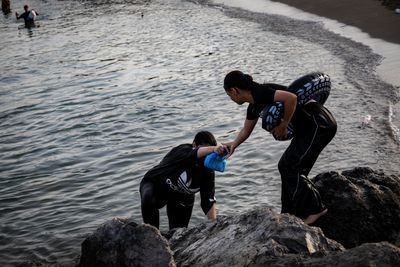
Unlike that episode, when thousands entered on foot after border controls collapsed, the land border is now tightly controlled and access to Ceuta is limited to authorised crossings. As a result, most migrants are attempting the dangerous sea crossing, often launching themselves into the water from beaches near the Moroccan town of Fnideq. Many of those arriving are unaccompanied minors.
Children are being transferred to emergency shelters established in former industrial warehouses in the Tarajal area, while adults are accommodated at Ceuta’s Temporary Migrant Reception Centre (CETI). Designed to host 512 people, the facility is now operating well above capacity. Hundreds of additional migrants remain outside the centre waiting for available places, as new arrivals continue throughout the day and night.
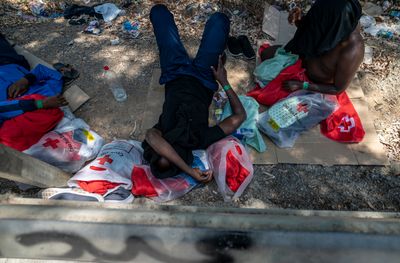
The road leading to the CETI has become a temporary encampment. Exhausted migrants rest on blankets distributed by the Spanish Red Cross, while others seek shelter beneath makeshift tents assembled from cardboard, plastic sheets and blankets to escape the summer heat.
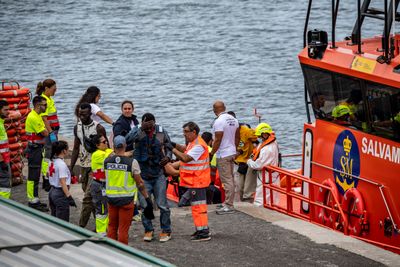
Spanish authorities continue to deploy Civil Guard patrol boats along the maritime border, while vessels from Morocco’s Royal Navy patrol the opposite side. Despite the constant surveillance, dozens of swimmers still attempt the crossing every day. From the Spanish shoreline, abandoned flotation devices can be seen drifting offshore after their owners successfully reached land.
When migrants are spotted in the water, Spanish officers frequently alert their Moroccan counterparts in the hope they can intercept them before they cross the maritime boundary. If a swimmer is already in Spanish waters or is considered to be in immediate danger, Spanish rescue teams intervene to prevent possible drownings.
The renewed migration pressure comes shortly after Spain’s Supreme Court ruled that migrants who reach Ceuta by sea cannot automatically be returned to Morocco under the summary return procedures traditionally applied at the land border. The judgment has introduced a significant legal change in the management of maritime arrivals, requiring individual administrative procedures for those who reach Spanish territory by sea.
Ceuta’s regional president, Juan Vivas, warned on Tuesday that the city is facing an exceptionally serious situation and called for an extraordinary response from the central government. He proposed studying the creation of a unified command structure capable of coordinating the actions of all administrations involved in managing the emergency.
According to Vivas, the Supreme Court’s interpretation of Spain’s immigration law has fundamentally altered the operational framework for dealing with maritime arrivals, making it considerably more difficult to return migrants who reach Ceuta by swimming. He argued that legislative changes would be necessary to adapt the legal framework while exceptional measures are adopted to cope with the current emergency.
Local authorities report that migration pressure has pushed the city’s reception system to its limits. The network caring for unaccompanied foreign minors has expanded from around 180 children only days ago to approximately 570, forcing emergency accommodation to be reopened and placing unprecedented strain on social services.
Vivas urged the Spanish government to adopt immediate measures, including the creation of additional reception facilities, financial assistance for emergency migration situations, reinforcement of police resources, legislative reform following the Supreme Court ruling and closer operational cooperation with Morocco to reduce irregular crossings.
He also argued that Ceuta’s geographical position as the European Union’s only land border with Africa requires a long-term structural response that balances humanitarian obligations with effective border management. According to the regional government, the priority must be both preventing further loss of life at sea and ensuring that the city’s reception capacity remains sustainable.
Despite continuous rescue operations and reinforced border surveillance, migrants continue entering Ceuta every day, keeping emergency services, humanitarian organisations and security forces under mounting pressure. Local authorities warn that if the current pace of arrivals continues, the enclave could face its most significant humanitarian challenge since the events of 2021.