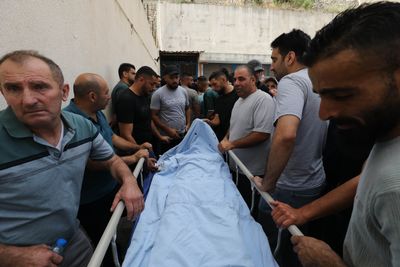


BEIRUT, LEBANON – As the sun set over Beirut’s southern suburbs on July 8, men and women slowly streamed into Ashura Square with Hezbollah and Iranian flags alongside with photographs of slain Hezbollah members and Iran’s Supreme Leader Ayatollah Ali Khamenei, for a funeral ceremony honoring the Islamic Republic’s longtime leader.
Funeral services were being held in Iran and Iraq for Khamenei, who was killed on February 28 at the beginning of a joint Israeli-American offensive against Iran aimed at toppling the regime and dismantling the country’s nuclear program. The gathering in Beirut was Hezbollah’s way of paying tribute to the man who had served as the party’s patron and spiritual guide for decades.
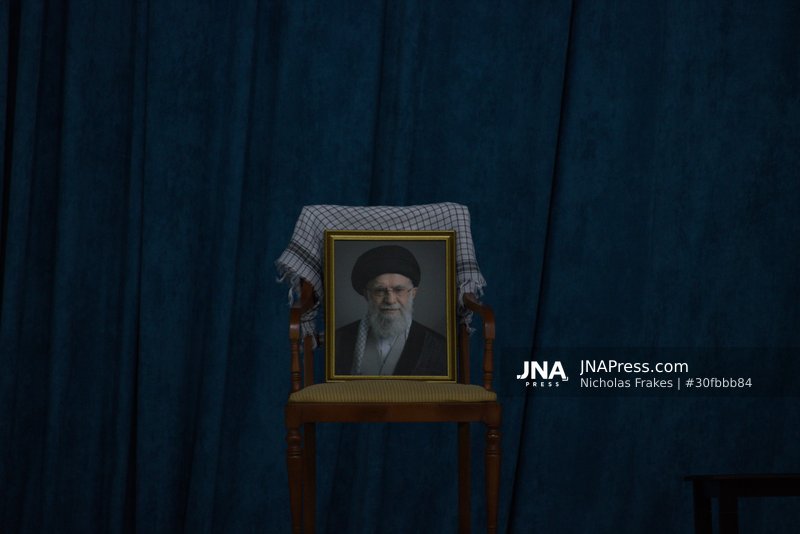
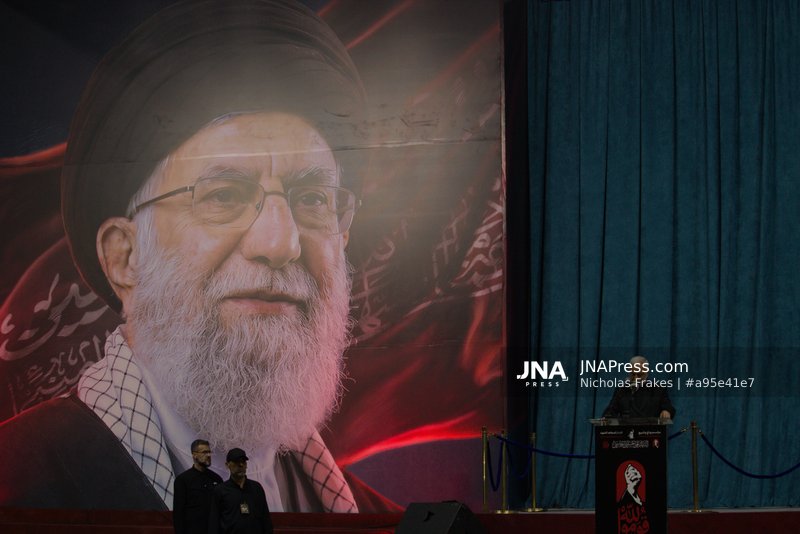
A portrait of Iran’s former leader sat on a lone chair on the stage as religious songs were performed. Hezbollah and Iranian officials, including Deputy Foreign Minister for Parliamentary and Consular Affairs Vahid Jalalzadeh, delivered speeches emphasizing defiance in the face of continued Israeli and American attacks on their countries, despite ceasefires in both Iran and Lebanon.
“The enemy must be answered and must not go unpunished,” Jalalzadeh thundered as he spoke behind the podium beside a large portrait of Khamenei. “Our martyred leader defended honor, pride and human dignity, and we were raised in his school upon these teachings.”
Those in the crowd agreed with the Iranian official, including 30-year-old Mehdi, who spoke to JNA Press on the condition that only his first name be used.
“We come from this school of Imam Hussein, which teaches us that we must sacrifice anything for righteousness and stand with the oppressed against the oppressors,” he said.
Following in the footsteps of Sayyed Ali
Speaker after speaker took to the stage to express their grief over the loss of Khamenei, but they all also insisted that they would continue to follow his teachings.
“As part of our historic commitment to the interests and sovereignty of Lebanon, we remain committed to the choices of the martyr Sayyid Ali Khamenei,” Jaafari Mufti Sheikh Ahmad Qabalan stated.
For Mehdi, however, the explanation was much simpler.
Khamenei was a leader who, in his view, helped lead a revolution in the name of the oppressed against their oppressors. He hoped that his “martyrdom” would inspire renewed commitment to the movement he helped build.
Some did not expect those outside of Hezbollah’s support base to understand their devotion to a man who many Western governments and rights groups described as an authoritarian who suppressed dissent.
To his supporters, however, Khamenei was the wali al-faqih, a righteous Shia leader who would guide the community until the return of the twelfth imam. They viewed him not only as a political leader, but also as a religious authority.
“Many people do not understand our way of thinking,” 64-year-old Osama Rahal told JNA Press. “We have principles that we follow in Islam, and we also follow the guidance of Sayyed Ali. That is why we love him, honor him, and are willing to make sacrifices. These are the values of our faith.”
Religion, she argued, teaches them about sacrifice, dignity and honor. For his supporters, Khamenei was the embodiment of these religious teachings, which they believe must be passed down from one generation to the next.
But the ceremony was about more than honoring Iran's former supreme leader. It was also about expressing solidarity with the Iranian people, who are still recovering from losses suffered during the height of the war in their country. Rahal noted that when Lebanon was in the same position, the Iranian people stood in solidarity with them, and therefore, it was only fair that they return the support.
“We are here to show the people of Iran that we stand by them, just as they stood by us when it came to Sayyed Hassan Nasrallah [former Hezbollah leader]. We love them, and we support them as they have supported us,” she explained.
Still, anger was evident throughout the crowd, along with calls for revenge over Khamenei's death. “We believe in an eye for an eye,” Mehdi said.
Strength through sacrifice
Despite a ceasefire in Lebanon and an agreement that was intended to see Israel forces withdraw from villages so that the Lebanese army could deploy there, Israeli strikes have continued in southern Lebanon on a daily basis, and Israel has shown no indication that it intends to fully redeploy its forces.
This has strengthened the arguments of critics who say the recent framework agreement between Lebanon and Israel is unlikely to succeed because, regardless of what is agreed upon, Israel will ultimately violate it.
“The framework agreement concluded by the Lebanese government serves Israel's interests entirely” Hezbollah leader Sheikh Naim Qassem stated during his televised speech concluding the ceremony. “If Israel alone had attempted to write this agreement, it would not have been able to accomplish it without cooperation from America and the Lebanese government.”
In Qassem’s view, while negotiations are not inherently wrong, it remains essential to be ready to continue fighting back Israel and to support Iran in its talks with the United States.
Rahal agreed, saying she stood with Hezbollah and Iran against Israel and the U.S. For her, the issue was personal: one of her sons had been killed during the fighting between Hezbollah and Israel.
She pushed back against critics of Hezbollah who said that the party had started a war on behalf of Iran; a war that Lebanon had no business being a part of.
“I am Lebanese, not Iranian, but I am a Muslim. I have religious principles that I want to uphold,” she insisted. “My son does not need to go to Iran to fight. Iran has its own people defending their country. My son belongs in Lebanon, defending his own land. That is why we offer our youth for the sake of Lebanon, not Iran.”
However, the willingness of Hezbollah and Iran's supporters to continue their fight did not mean that they were actively seeking another war.
Mehdi was quick to point out that, as Muslims, they are firm believers in peace. However, since Israel has so far been unwilling to abide by any ceasefire agreement, someone had to intervene to put an end to it.
During nearly three years of war with Israel, Hezbollah has lost thousands of soldiers, most of its leadership and much of its infrastructure.
For committed supporters of Hezbollah like Rahal, however, those who believed that the party and Iran were weakened by these losses failed to understand them and the importance of their religious commitment.
“Every time we make sacrifices, we become stronger,” she said. “Every sacrifice brings us greater strength because God is with us. We have strength, we have principles, and we love our people. God gives us the strength to continue.”
This became all the more evident as chants of “We will not be humiliated” echoed among the buildings surrounding the square.
As religious recitations began, the crowd began to make their way back to their homes, carrying with them a message that had been repeated throughout the night: even though Khamenei was gone, they were far from being defeated.
“We hope that his martyrdom will bring another spark to this revolution,” Mehdi said.
Photo and text by Nicholas Frakes/JNA Press

Nicholas Frakes
Author at JNA Press
I am a journalist and photojournalist based in Lebanon covering the Middle East. I have worked in the region for nearly a decade and have covered everything from popular uprisings to economic crises to the recent wars in Lebanon.
View Profile