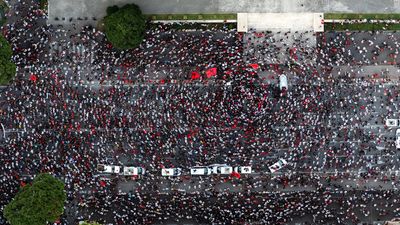

BANDUNG, Indonesia— Hundreds of students in Bandung, West Java, Indonesia, held a protest against several government policies considered burdensome to the community. They also stated that they would increase the scale of the action if the demands presented do not receive a response from the government.
The demonstration highlighted several pressing national issues, including the sharp depreciation of the Rupiah, the recent hike in fuel (BBM) prices, and the discussion of draft laws seen as potentially narrowing civil space.
"We are the Indonesian people who are angry with the policies issued by the government, but we still carry them out very well. We are in accordance with the procedures stipulated in the law," said one of the protesters, Muhammad Azhar Ibrahim.
Azhar said that this action is part of a series of mobilizations prepared by students. According to him, follow-up actions with a larger number of people can be carried out if the aspirations conveyed are not accommodated.
Observation at the location showed that the protesters, who were predominantly students dressed in black, began to gather on Jalan Diponegoro, in front of the West Java DPRD Building, at around 15:30 WIB.
They carried various protest attributes such as flags, posters, and banners bearing slogans including "Refuse, Resist, Revolt" and "Critical Rupiah, People Cry, Prabowo to Paris," while chanting "Long Live the Indonesian People."
Orations were delivered alternately. Speakers voiced their disappointment with the Prabowo administration, the weakening value of the rupiah, and called on the government to immediately address issues burdening the public with concrete solutions.
Meanwhile, a representative of the National Student Front, Ainul Mardhyah, said the protesters' main demand is to push for the implementation of agrarian reform and national industrialization, which are considered solutions to various economic and social problems.
The protesters also urged the government to stop the Free Nutritious Meal (MBG) program, lower fuel prices, and provide free education.
According to an official statement from the National Nutrition Agency (BGN), which is responsible for managing the MBG program, the budget allocation for the initiative in 2026 reaches Rp268 trillion. The funds come from the State Revenue and Expenditure Budget (APBN).
She argued that the MBG budget should instead be redirected to expand access to education. The increase in education costs, she said, has the potential to further burden students, especially amid economic pressure and the weakening rupiah exchange rate
"We want to urge the state to realize true agrarian reform and national industrialization as a way out of the many forms of oppression we experience," Ainul said.
Public concern intensified after the rupiah weakened to around Rp18,000 per US dollar this week. The depreciation is feared to affect the prices of daily necessities.
In Bandung, the price of cooking oil reached Rp21,000, exceeding the government’s highest retail price (HET). Other basic commodities that saw increases included curly chilies, whose price rose from Rp48,500 to Rp70,000
Adding to the concerns, President Prabowo Subianto’s flagship Free Nutritious Meal (MBG) program has been hit by allegations of corruption. Former National Nutrition Agency (BGN) head Dadan Hindayana and two of his deputies are suspected of carrying out a mark-up scheme that allegedly caused state losses.
Most recently, non-subsidized fuel products, including Pertamax and Pertamax Green 95, experienced price increases. Protesters argued that this development would further burden the public.
The domestic economic situation is also seen as being influenced by the escalating conflict in the Middle East. Rising geopolitical tensions have triggered instability in global markets and pushed up world crude oil prices.
This situation has been cited as one of the factors behind the increase in domestic non-subsidized fuel prices and the strengthening of the US dollar against many global currencies, including the rupiah.
For that reason, the protesters called on the government to immediately evaluate the situation and provide solutions. Ainul said demonstration actions would continue periodically as a form of political pressure on the government.
"If one thinks that the action is only limited to today, no. We will ensure that in the coming days we will continue to take action," she said.
Photos by Gilang / JNA Press