

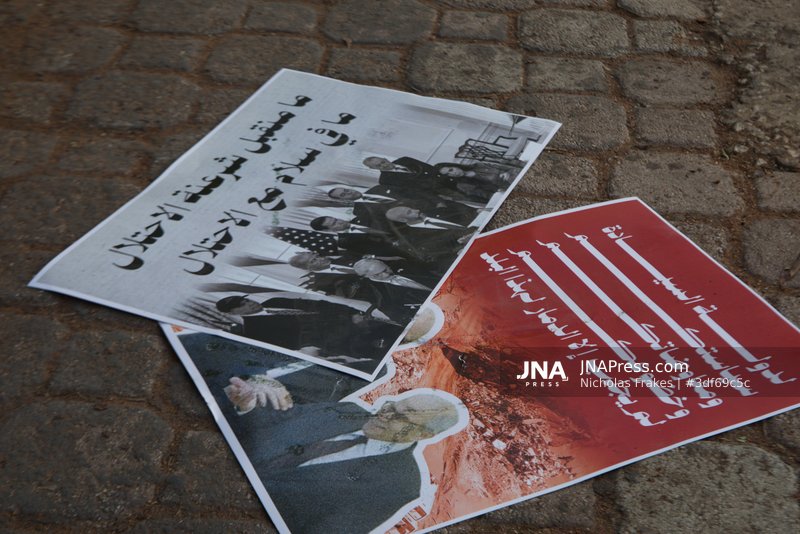
Beirut, Lebanon – A young boy jumped up and down on two posters strewn across the sidewalk in the Haret Hreik neighborhood of Beirut’s southern suburbs with a look of pure frustration and rage plastered across his face. The posters were of the Lebanese prime minister, Nawaf Salam, and the signing of the June framework agreement between Lebanon and Israel.
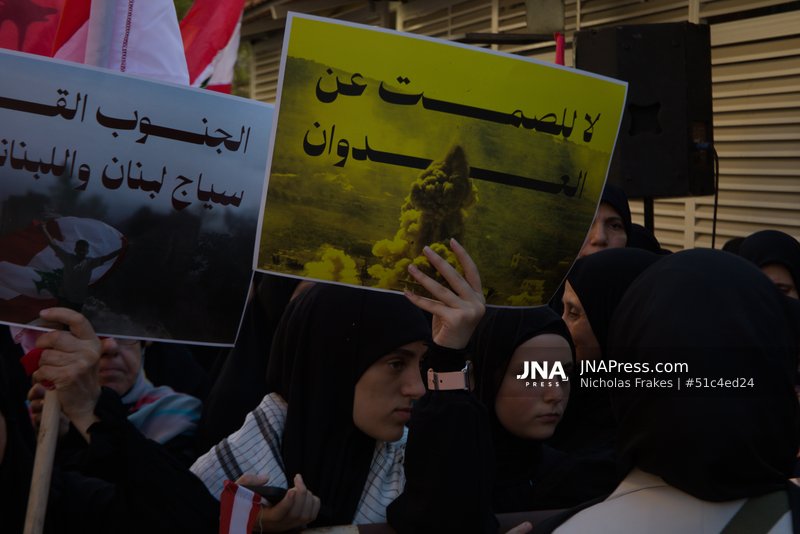
“We will not accept an Israeli occupation. There is no peace in occupation,” read one. “For the sovereign government, your politics, your negotiations, your surrender only brought destruction to this country,” read the other.
The boy and his mother were taking part in a protest against Israel’s continued occupation of parts of southern Lebanon, the daily destruction of southern villages, and what demonstrators argued was the failure of the Lebanese government to prevent any of this.
While most of those attending the protest, waving an array of Lebanon and Hezbollah flags and holding posters, hailed from the south, at least by origin, some had come from other parts of the country to show their support for their fellow countrymen.
One of them was political activist Ruqaya Njaid, who stood out with her bright blue hijab amid a sea of women wearing black abayas. “I’m here today from Baalbeck to say that the south and Lebanon are one,” she told JNA Press sternly. “What happens in the south today will happen in Lebanon tomorrow. And the fire that burns your neighbors, the people of Lebanon, our partners in this country, may burn you tomorrow.”
Homes turned into rubble
Since Israel first invaded Lebanon on March 3, 2026, the day after the start of the latest war, its forces have steadily demolished homes and entire villages in the border region, often publishing video of the controlled demolitions. On top of that, Israel has continued bombing villages farther from the border, leaving vast swathes of them in ruins.
In August, an Israeli news channel, using satellite imagery, found that the Israeli military had destroyed upwards of 18,000 buildings in just 19 villages in the border region. Khiam and Odaisseh were estimated at 90 percent destroyed. Hula was 83 percent destroyed. Taybeh was 65 percent destroyed. And Marwahin was completely destroyed.
As people shouted out “Labayka ya Jnoub (We are at your command, oh south)” with raised fists, Sheikh Ali al-Khatib, vice president of Lebanon’s Supreme Shia Islamic Council, spoke of the situation southerners were facing. “You [southerners] are paying the price of your freedom, so the free people do not ask about anything when it comes to dignity and when it comes to history and when it comes to the land, you have sacrificed what no one has explained,” he bellowed into the microphone, his voice drowning out the bustling traffic nearby. “They want to erase our history and they will not be able to, and the South will not be liberated except by your children.”
The sheikh’s words resonated with many in attendance. Some had lost their homes. Others could not return to their villages because they were still occupied. In Mahmoud Asayeli’s case, it was both.
Originally from the village of Rshaf in the Bint Jbeil district on the border, Asayeli saw his village destroyed and neighboring towns meet a similar fate. “We have a lot of memories in the village,” he told JNA Press. “We live in Beirut, and we go to the village on weekends.”
The ongoing situation in southern Lebanon infuriated the demonstrators, particularly the women, who shouted slogan after slogan. “We will not be humiliated!” “Death to America!” “We are at your command, oh south!”. For Njaid, she pushed back on anyone who would criticize them for their anger, pointing to what was happening every day in the south. “This is people that is angry. This is a resisting environment. Their south is being blown up. Their land is being blown up. Their youth is being killed. So don’t blame us,” she exclaimed.
It was not only the Israelis at whom people were angry at, though. Many also viewed the Lebanese government as having failed in its duty to protect the country despite repeated assurances that direct negotiations would lead to an end to the war and Israel’s withdrawal.
No confidence
Prime Minister Salam has consistently stated that the arms of a non-state actor would not force Israel to end the war and withdraw. The only way to achieve any of that would be through negotiations. That was his justification for starting direct negotiations, mediated by the United States, which culminated in a June 26 framework agreement that was supposed to end the fighting and allow southerners to gradually return to their homes.
However, since Israel continues to bomb the south and demolish villages, while also stalling the withdrawal process, southerners have little hope that negotiations will achieve anything. “The negotiations are very bad. There shouldn’t be any negotiations. Negotiations should never take place under fire,” Asayeli said. “There shouldn’t be any negotiations between Israel and Lebanon. Israel doesn’t commit to anything.”
A major reason for southerners’ skepticism stems from the 15 months between a first war – which lasted from Oct. 8, 2023 until Nov. 27, 2024 – and the recent war, during which Israel also continued to bomb south Lebanon daily despite a ceasefire agreement.
Despite the seeming lack of results from the negotiations, Salam insists that the government is fighting for the south and its people. “We have placed the rehabilitation of infrastructure in the south and supporting the resilience of its people at the heart of our government’s priorities,” the prime minister said in a statement released at the same time as the protest. “This is what we are working on: to ensure the state is present alongside the people of the south, and to gradually rebuild what the attacks destroyed and secure the foundations for resilience and return.”
As much as he wants to believe what Salam says, Asayeli feels that much of it ings hollow. “We are with the state. The state should provide us with our rights,” he explained before adding that the Lebanese government's handling of the situation had caused him to lose confidence in it. “Of course, there shouldn’t be any distrust, but there is doubt in that trust.”
Others took a harsher tone when discussing the government and the negotiations with Israel. In Njaid’s telling, the talks have been nothing short of a failure and have only brought more death and destruction to Lebanon. “When we see all this destruction in the south, this is only a picture, a picture of the framework agreement. Anyone who wants to know about the framework agreement should look at the destruction in the south,” she stated.
As the demonstrators began to file out of the courtyard, they knew that the situation in the south was not going to end anytime soon. If anything, it would persist for the foreseeable future.
More Israeli bombs would be dropped on the south, destroying homes and killing people. More villages would be destroyed. If they could not trust the government to put an end to the death and destruction, then, in their eyes, that left few other options than Hezbollah. For southerners, Hezbollah may have gotten them into these wars, but it was also a group that was deeply embedded in their lives. Women held up their phones, displaying pictures of Hezbollah members, their loved ones who were killed in the recent wars.
Since the announcement of the framework agreement, Hezbollah has largely held off on launching any attacks on Israeli forces. Some speculated that the party was hit hard in the war and was rebuilding its forces. Even if that was the case, they were still sure that it would return. “With time, it can rebuild itself. Even if it is reduced to nothing,” Asayeli stated. “It can rebuild itself, and all the occupiers will leave the country.”

Nicholas Frakes
Author at JNA Press
I am a journalist and photojournalist based in Lebanon covering the Middle East. I have worked in the region for nearly a decade and have covered everything from popular uprisings to economic crises to the recent wars in Lebanon.
View Profile