

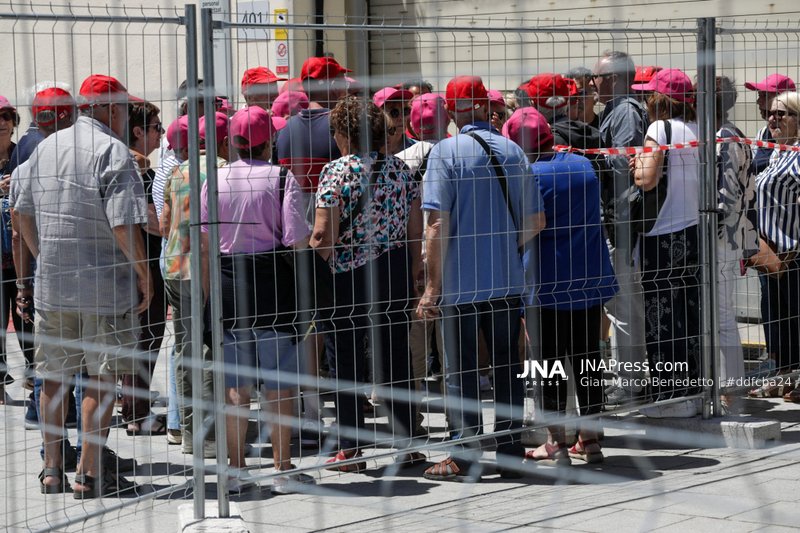
BARCELONA, Spain— “I don’t work those days for my personal safety,” jokes Carlos, a tour guide in Barcelona, for whom the Pope’s visit has been the perfect excuse to take a few days off. Faced with the flood of national and international tourists, he has decided it is better to watch it from home. “I imagine it must be exciting; it has a very ominous undertone,” says the young man.
Pope Leo XIV will arrive in Barcelona on Tuesday, June 9, 2026, at 12:25 p.m., after spending a few days in Madrid. His stay in Catalonia will last until Thursday, June 11, when he will depart for Las Palmas de Gran Canaria. Hundreds of people and tourists are eager for his visit. Some are hoping the Pontiff will bless their baby from the popemobile. “Imagine explaining years later that the Pope of Rome blessed them,” says Marta, a Franciscan who, despite not practicing the faith, is moved by the event.
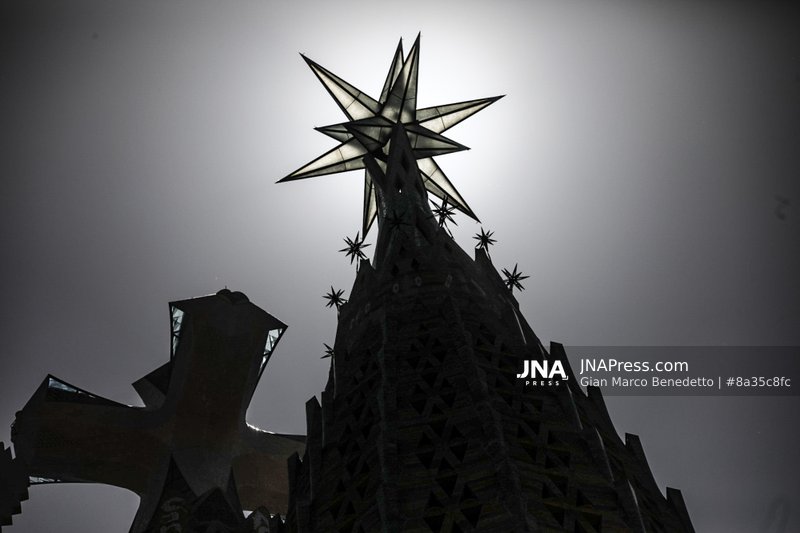
The event at Antoni Gaudí’s Sagrada Família basilica, coinciding with the centenary of the architect’s death, will host a total of 8,000 people—4,000 inside the basilica and another 4,000 outside, in front of the Nativity façade.
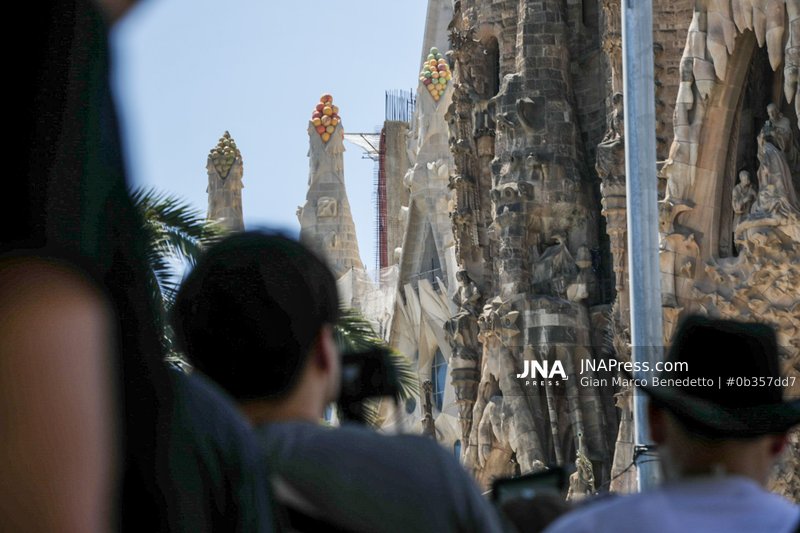
Outside, another 4,000 people will gather for the blessing of the Tower of Jesus Christ. Around 3,000 of them will be members of Christian communities, while about 1,000 will be institutional guests.
The most crowded event will be the prayer vigil, in which nearly 40,000 people are expected to take part.
Souvenir shops are already stocking up on merchandise, from certificates of the visit to magnets, badges, fans, and even Vatican-coloured scarves, which are not very popular with summer approaching. “We always come prepared,” smiles Miriam, showing an umbrella in her tote bag. She, like others, knows they will have to wait for hours to “get a good spot,” and the expected sunny temperatures of 24 to 27 degrees Celsius may be the biggest challenge of the day.
Not everyone welcomes the visit. Several secular organizations are questioning the “privileges” granted to the Vatican, as a head of state, by the city of Barcelona and the Spanish state during Pope Leo XIV’s visit. They have called a protest for June 9 at 7 p.m. at Passeig del Born, precisely while the Pope holds the major Eucharistic celebration at the Olympic Stadium in Montjuïc.
The Ferrer i Guàrdia Foundation, Europa Laica, and Ateus de Catalunya presented a manifesto last Friday stating that the Vatican “maintains a debt with memory” due to its “absence,” as they describe it, during the 1936 military coup that led to the Spanish Civil War. At the same time, they argue that issues such as abortion and euthanasia should not be brought back into public debate.
The Pontiff calls on Europe to "rediscover dialogue" in response to growing militarization
The third day of Pope Leo XIV’s visit to Spain revealed its most ideological dimension through the Pontiff’s address before the Congress of Deputies and its lawmakers. At a time of intense political polarization within Spain’s parliamentary chambers, Leo XIV delivered a speech on Monday focused on international responsibility, peace, and the defense of human dignity. It marked the first time in Spanish history that a pontiff has addressed the lower house chamber.
The international situation formed one of the central pillars of his message. He warned of a growing climate of “mutual distrust” among states and argued that “peace requires diplomatic courage.” He also insisted that “every war constitutes a painful defeat” and cautioned that “weapons may impose a temporary silence, but they can never build a lasting peace.”
In this context, he expressed concern that rearmament is increasingly being presented as the primary response to the current geopolitical situation, particularly in Europe. “It is concerning that rearmament is being presented as a response to the international landscape, especially in Europe,” he said. Instead, he argued that the international community, and Europe in particular, is being called upon to “rediscover dialogue” as a fundamental tool for resolving conflicts.
Although he made no explicit reference to specific events, his remarks came just hours after an Iranian attack on Israeli territory. It was the first direct exchange of fire between Israel and Iran since the ceasefire brokered by the United States on April 8. The trigger for the latest escalation was an Israeli airstrike on the Lebanese capital on Sunday morning, which left two people dead and around ten others injured.
The Pontiff reiterated the need to halt the cycle of confrontation and to pursue diplomatic solutions. The historic address concluded with a call to strengthen dialogue among nations and to build an international order based on cooperation, justice, and respect for human dignity, a message that resonated in a chamber marked by deep political divisions.
The President of the Congress, Francina Armengol, opened the event with an appeal for understanding amid an especially turbulent international context. “In times of polarization, we must restore the international order. Our task must never be to multiply conflicts, but to solve them,” she said, placing particular emphasis on the international crises affecting the world.
During his speech, Leo XIV highlighted the value of democratic institutions as spaces for encounter and consensus. “Here, differences are heard and transformed into shared decisions,” he said, before praising Spain’s historical trajectory and its ability to combine political action with ethical principles. “Spain has known how to unite historical action with the clarity of moral reason,” he stated, pointing to the particular role of the Spanish state in defending international law.
The Pontiff also engaged in self-criticism by acknowledging that “society and the Church have not always lived up to their responsibilities.” However, he noted that the Church remains one of the world’s oldest diplomatic institutions, particularly in promoting human dignity and the common good and placing them at the center of public action. “May human dignity and the common good be the measure of human relations, both nationally and internationally,” he urged. In the same vein, he warned that “when the common good is no longer the horizon, public action becomes fragmented.”
Leo XIV also defended the protection of human life “until its natural end,” emphasizing that “every human life must be safeguarded.”
The Pope dedicated a specific section of his speech to migration, which he described as “a tragic drama” that directly challenges the conscience of nations. According to him, this reality requires coordinated responses rooted in solidarity. The Pontiff’s remarks stand in contrast to the “national priority” agenda promoted by right-wing and far-right political forces in Spain, which oppose welcoming immigration with open arms. The Pontiff stressed that moral values must be put into practice and that this begins with preserving every aspect of “human dignity.”