

BARCELONA, Spain—“He’s got an angel. He looks like a good man, despite being American!” exclaims Leticia among hundreds of people gathered outside Barcelona Cathedral. She does not mind being far from the thick of the crowd, where thousands are waiting for a blessing or even a simple greeting from the Pontiff on his first day in the city. “The blessing reaches you wherever you are; it doesn’t matter where you stand,” confides Leti, who crossed the Atlantic from Mexico to see her daughter, Estefanía. “Of course. The Pope is the icing on the cake,” she smiles.
The crowds are smaller than in Madrid, but no less enthusiastic. “This is the Pope’s youth!” shout young people waving Vatican flags. “What enthusiasm, so many young people!” marvel mother and daughter, who had assumed that religion was mainly for “older people.”
Inside the Cathedral, the Pontiff alternated between Catalan and Spanish to express his concern about “not allowing anything to destroy unity.” His use of Catalonia’s own language, and that of Barcelona’s patron saints, came as a surprise to many. In fact, it was also a request made by Catalan pro-independence conservative parliamentary representative Míriam Nogueras, who told him at the Congress of Deputies that “speaking the language of the land you visit is an act of respect,” delivering the message in both English and Italian.
“In a world torn apart by wars and divisions, in a society that is becoming increasingly fragmented, we want to be martyrs, witnesses and prophets of unity and welcome, even at the cost of sacrifices and renunciations,” he said during his homily.
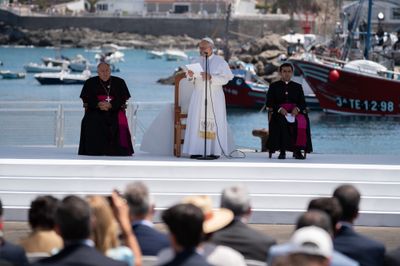
“Thank you for your joy, for your faith. Adéu-siau,” Pope Leo XIV told the faithful gathered in the square, where he sought to convey a message of unity within diversity.