

Pope Leo XIV thanks Spain for its “fidelity to international law” in the face of conflicts in Ukraine and the Middle East
The Pontiff calls for dialogue “among Christians, Muslims, and Jews” as a path to peace and coexistence during his visit to Spain
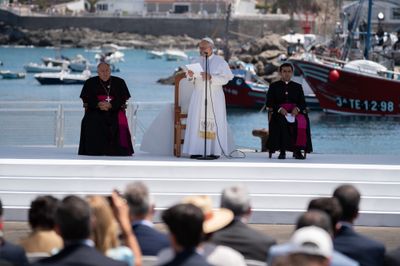
MADRID, Spain— Pope Leo XIV delivered a highly diplomatic speech on the first day of his visit to Spain, in which he called for interreligious dialogue as an essential tool for world peace. As part of his first official visit to the country, the Pontiff explicitly thanked Spain for its “fidelity to international law and multilateralism,” highlighting its commitment to peace and cooperation among peoples in a context marked by conflicts such as the war in Ukraine and the escalation of violence in Lebanon and Gaza involving Israeli forces.
The Pontiff stressed the need to strengthen interfaith dialogue as an essential tool for international stability, evoking the historical experience of the Iberian Peninsula during the Islamic presence. He recalled that this period was not only marked by “conflict,” but also by “a dialogue around the meaning of truth among Christians, Muslims, and Jews,” which enabled the exchange of knowledge and the creation of shared spaces for reflection.
In this context, he highlighted examples such as the School of Translators of Toledo and cities like Córdoba and Toledo, where different religious and cultural traditions collaborated in the transmission of philosophical, scientific, and theological knowledge based on ancient texts in Aramaic, Hebrew, and Greek.
Leo XIV framed this legacy in the present day, arguing that coexistence among religions is not an abstract ideal, but a concrete necessity in a world marked by conflict. “The temptation to gain popularity by fueling the flames of polarization seems to be growing rather than diminishing,” Leo XIV warned, noting that “human dignity continues to be violated.”
Faced with dynamics of division and the simplification of reality in public life, he called for a “culture of encounter”—a term used by his predecessor, Pope Francis—based on education, freedom of conscience, and respect for human dignity. “Religious freedom must be protected,” the Pontiff added, without excluding any religion.
He also thanked Spain for its role in dialogue in conflicts and its willingness to confront injustice, and said that the country is a European example, highlighting its contribution to global cooperation in an international context marked by armed conflicts and geopolitical tensions. “I see here a specific vocation of Europe, of which Spain is a protagonist, original and fundamental,” Leo XIV explained. “It is the gift that the old continent can offer the world if it wishes to remain young, for it is young who feel they have a future and a mission that still challenges them,” he added.
The Pontiff encouraged fostering “dialogue and social friendship” as the basis for addressing future challenges with hope and shared responsibilit.
A Continuing Social Dimension
Pope Leo XIV has visited the CEDIA 24 Horas social center of Cáritas Diocesana de Madrid, in a meeting focused on the reality of homeless people and migrants, where he listened to various life stories of struggle and recovery.
The Archbishop of Madrid, José Cobo, also recalled the Church’s extensive social work in the diocese, highlighting that “last year, Cáritas Diocesana de Madrid accompanied nearly 90,000 people in parishes and more than 400 social projects aimed at families, homeless people, migrants, young people, and the elderly,” in addition to “another 300 projects promoted by consecrated life and different ecclesial realities.” According to Cobo, the CEDIA center “is an example of all this,” where “it is precisely the most vulnerable who today want to welcome the Pope and show him their affection.”
For his part, the director of Cáritas Diocesana de Madrid, Luis Hernández, thanked the Pontiff for his visit and pointed out that “the last shall be first,” referring to the fact that Pope Leo XIV’s itinerary begins this Saturday by attending social organizations and their users, and will end on June 12 in Canary Islands.
During the tour of the center, the Pontiff heard several testimonies, including that of Khadry, a Senegalese migrant who arrived in Spain during the pandemic after a journey through the Canary Islands and was later taken in in Madrid. Khadry recounted how he spent his first months in loneliness until the support of Cáritas allowed him to rebuild his life.
The Pontiff also offered a social and political reflection, calling on “some Christians” to “read the Gospel again” and warning against the influence of “worldly ideologies or political and economic positions that lead to unjust generalizations and misleading conclusions,” in reference to discourses that criminalize immigration.
The event concluded with the blessing of around 80 social organizations present, which the Pope described as “a sign of hope and of the Gospel in a society marked by indifference.”
The Pontiff’s visit began with a social dimension, including earlier meetings with people with disabilities cared for by Madrid-based organizations, as well as with migrants, homeless people, and individuals with addictions or mental illnesses, in a day focused on attention to vulnerability and exclusion.
The trip will conclude in the Canary Islands, considered one of the main entry points for migration into Europe. So far in 2026, a total of 2,276 migrants have arrived irregularly in the archipelago in the first four months of the year, while in 2025 the figure rose to 17,788 people arriving by sea, according to data from the Ministry of the Interior. This is one of the most dangerous routes, which claimed the lives of more than 1,100 people last year. A circle that begins and ends with those most in need.
Pope Leo XIV has concluded the first day of his visit to Spain with a youth vigil organized by young people, who selected six questions addressing their main concerns. The gathering, attended by around half a million people in Plaza de Lima, according to figures provided by the Government Delegation, featured a schedule repeatedly interrupted by greetings and blessings to the faithful in attendance.