

During a historic Corpus Christi procession held abroad for the first time, the Pontiff defended migrants, condemned division, and called on Christians to stand with the poor and marginalized
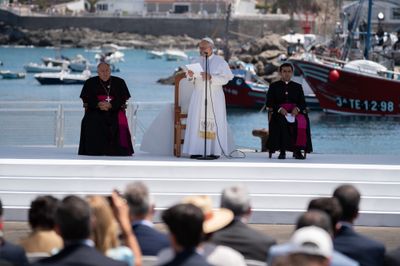
MADRID, Spain— Pope Leo XIV received a massive welcome from more than 1.5 million people attending the Corpus Christi Mass, marking the first papal procession ever held on foreign soil.
Delivering a subtle political message, he reminded the faithful that Jesus Christ “identifies himself with the poor, the lonely, and the abandoned,” emphasizing that true Christians are defenders of peace. The Pontiff described Christ as a source of security for those who have lost everything, a promise “to the poor, to those who suffer, and to those who have lost hope.” In doing so, he reaffirmed the authentic values of Christianity during a large-scale celebration attended by representatives of various religious communities.
In this way, he challenged narratives which, as he suggested on the first day of his visit, are driven by “worldly ideologies or political and economic positions that lead to unfair generalizations and misleading conclusions.” His remarks appeared to allude to Spain’s far right, which opposes the government’s large-scale immigration regularization programme promoted by Prime Minister Pedro Sánchez. The initiative has allowed nearly 550,000 migrants to apply for extraordinary legal status. Conservative and far-right parties have accused the government of allowing “criminals with prior records” into the country, rhetoric that contrasts sharply with the Pope’s message.
Madrid’s mayor, José Luis Martínez-Almeida, a leading conservative figure, presented Pope Leo XIV with the city’s Golden Key and invited him to sign the official Book of the City. “May Madrid continue to be a welcoming and inclusive city, where social life is inspired by authentic human values,” the Holy Father wrote, in what many interpreted as a clear statement against the politics of hatred.
During the Mass, the Pope once again warned against the manipulation of Christianity’s humanistic message. “No one can kneel before the Lord and at the same time despise a brother or sister,” he said in his homily.
An Opportunity for Interfaith Dialogue
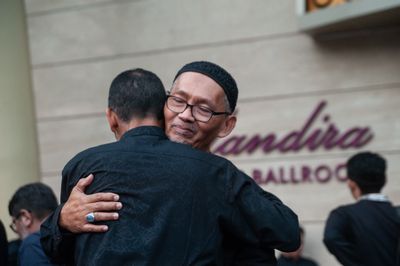
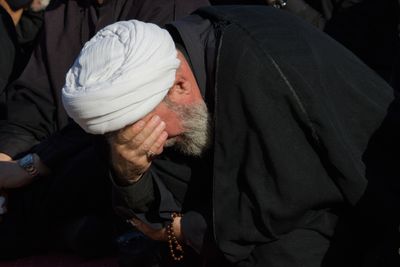
The Pontiff’s visit to Spain has opened the door to a level of interfaith dialogue previously considered impossible. Religious communities, particularly Muslim organizations, have welcomed his message of peace and human dignity in response to the conflicts affecting the world today.
In particular, the various faith groups present in the Canary Islands—the final destination of the Holy Father’s visit—have expressed strong interest in engaging with him. According to local media, Muslim, Hindu, and Jewish communities alike are eagerly anticipating his arrival. Hamed Al-lal, president of the Islamic Federation of the Canary Islands, stated that the Pope’s visit could strengthen understanding between different religious communities.
Although he acknowledged that there is no official position from his organization regarding the Pontiff’s visit, Al-lal described it as an event of great social significance that extends far beyond the Catholic sphere. He argued that different religions share a common ethical foundation.
“All of them seek to convey a similar message: to treat others as we would like to be treated ourselves, even if each faith expresses and practices that principle in different ways,” he said with a smile.
The perspectives of art and science
The Pope’s agenda moved in the afternoon to the Movistar Arena, where 12,000 people heard from actors of civil society, representatives of art, science, education, and sport, who shared their concerns with the Pontiff.
Actor and film director Antonio Banderas intervened to express that “this is not a visit, but a gesture” regarding the pending issues.
On behalf of the artistic sector, Banderas acknowledged that art “is not only beauty, but also question and revolution.” “Art is the mirror that denounces empty creeds,” he stated, adding that it is the only “alternative to violence”—“to all forms of violence,” he reiterated.
The Spanish actor conveyed to Pope Leo XIV the shared responsibility that “we are obliged to look and to see” beyond the obvious.
In a similar vein, the representative of the education sector, the vice-rector of the Complutense University of Madrid, José María Cuello, questioned “what academia and science can do to lead technological change,” directly referring to the Pontiff’s encyclical letter, which pointed to the need to preserve what is human in the face of the rise of artificial intelligence and the identity risks it poses for society.
He was followed by four representatives from trade unions and employers’ organizations, who called for “a new social contract” in order not to “close ourselves off among those who are identical,” but instead to broaden solidarity with the “anonymous,” as stated by the secretary of the trade union Comisiones Obreras, Unai Sordo, and the general secretary of the General Union of Workers (UGT), Pepe Álvarez. The shared commitment is to leave no one behind, especially “workers in the most vulnerable situations.”
On the sports side, Olympic medalist Carolina Marín and Paralympic medalist Teresa Perales wanted to convey the “pure joy of playing for the sake of playing.” “You have reminded us that falling is not the end of the road.” “The rules of the game are not a limitation, but the lines that make it possible for us to meet fairly on the court; under those rules, competing does not mean destroying the opponent,” Marín stated, adding that “the adversary is not an enemy but a companion on the journey who pushes us to give the best of ourselves.” The champions’ speeches aim to show that not everything is acceptable, that resilience and hard work are born from effort and a sense of companionship among rivals on the field, and that mutual understanding is possible if there is respect.
The Pontiff acknowledged the doubts raised by the speakers, questioning “what legacy we are leaving for the future and what kind of community we are building.” The Church, the Holy Father says, does not “disengage from anything human,” and that a “spirit of dialogue is an integral part of its vocation.”