TORELLÓ, Catalonia — On a football field in the Catalan town of Torelló, spectators gathered expecting an artistic performance. What they witnessed instead was a provocative visual statement that immediately sparked debate across Spain.
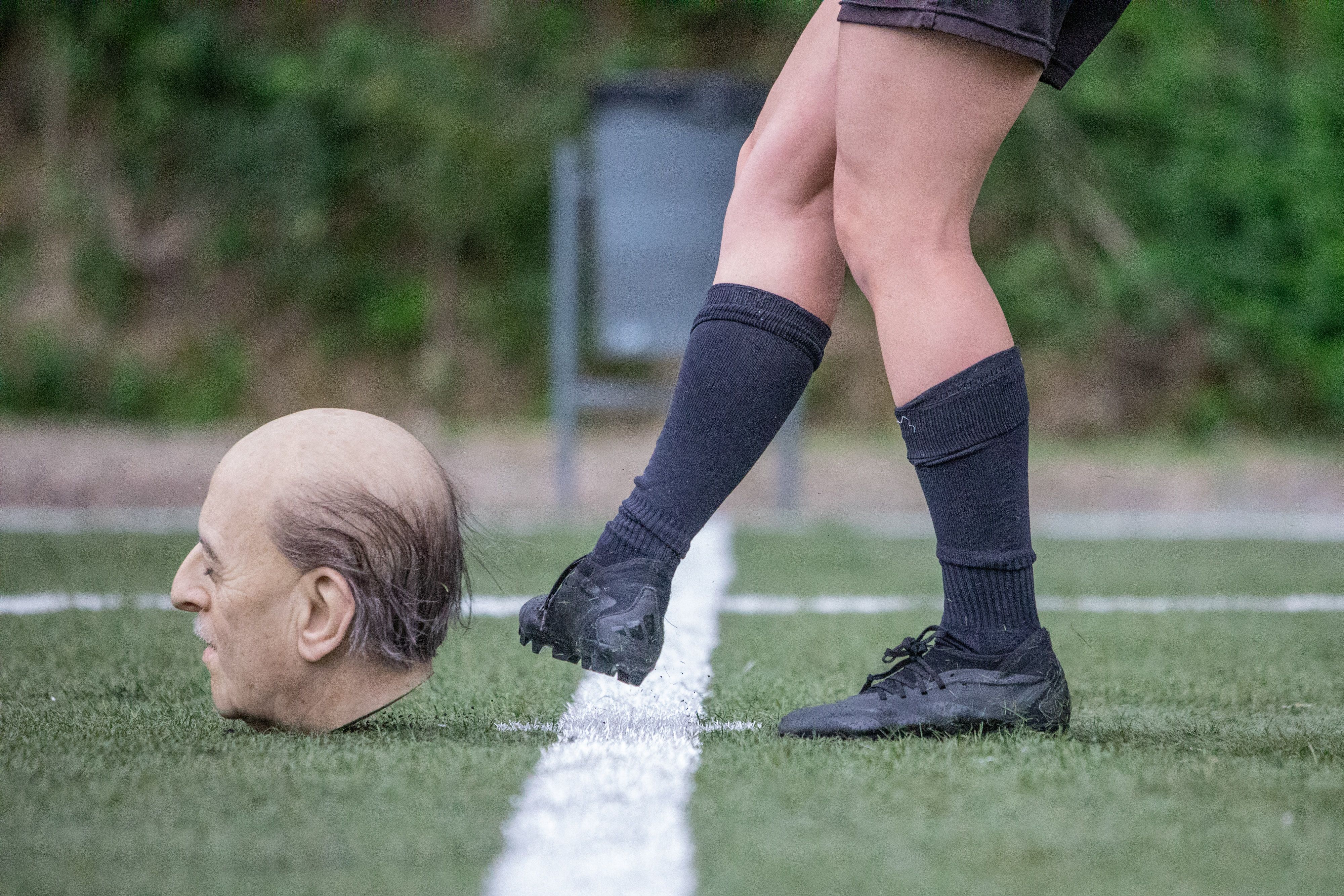
Players kicked what appeared to be the head of former Spanish dictator Francisco Franco.
The performance, titled La Copa del Generalísimo, was created by Spanish artist Eugenio Merino and the American collective INDECLINE and staged as part of the Festus Festival to mark the 90th anniversary of the outbreak of the Spanish Civil War.
While the scene may appear shocking at first glance, the organizers insist the objective was not merely provocation. The project was designed to challenge audiences to confront one of the most sensitive questions in modern Spain: How should the country remember its past?
A Dictator Who Still Divides Spain
Francisco Franco remains one of the most controversial figures in Spanish history.
After emerging victorious in the Spanish Civil War (1936–1939), Franco established a dictatorship that lasted until his death in 1975. During nearly four decades in power, political opposition was suppressed, civil liberties were restricted, and thousands of Spaniards faced imprisonment, exile, or execution.
For many Spaniards, Franco’s regime symbolizes authoritarianism and repression. For others, particularly among conservative circles, his rule is remembered differently, often associated with political stability and national unity during a turbulent period.
This division continues to influence Spanish politics, education, public memory, and cultural debates.
Nearly fifty years after the death of the dictator, disagreements over monuments, street names, historical archives, and public commemorations remain a recurring feature of Spanish public life.
The Symbolism Behind the Football Match
The title of the performance references the historical Copa del Generalísimo, the name once given to Spain’s national football cup competition during Franco’s dictatorship.
By transforming Franco’s likeness into a football, the artist sought to reverse the symbolism of power associated with the former ruler. According to the creators, the work examines how historical figures are remembered, challenged, and reinterpreted by later generations.
In contemporary Spain, questions about the past are not merely academic. They remain connected to issues of identity, democracy, regional politics, and national reconciliation.
Art as Political Commentary
Artist Eugenio Merino has built an international reputation through works that explore power, memory, religion, and political history.
His projects frequently generate controversy, and several of his previous works related to Franco have led to legal disputes and public debate.
The controversy surrounding Merino’s work is not new. Over the years, the artist has faced legal challenges from the Francisco Franco Foundation, an organization dedicated to preserving the legacy of the former dictator. The foundation filed lawsuits against Merino over artworks it considered offensive to Franco’s memory. However, Spanish judges ruled in the artist’s favor on two separate occasions, finding no grounds for conviction and reaffirming the principle of artistic freedom and freedom of expression.
Supporters of the Torelló performance praised the project as a creative exploration of historical memory and democratic values. Critics accused the artist of disrespecting a historical figure and deepening social divisions.
The polarized reactions illustrate how unresolved aspects of Spain’s twentieth-century history continue to shape contemporary cultural debates.
Historical Memory in Modern Spain
In recent years, Spain has undertaken several initiatives aimed at addressing the legacy of the Civil War and the dictatorship.
Government policies have sought to identify victims of political violence, support historical investigations, and remove public symbols associated with Franco’s regime. These efforts have received both praise and criticism, reflecting the complexity of reconciling historical justice with differing interpretations of national history.
The debate intensified in recent years when Franco’s remains were exhumed from the Valley of the Fallen monument and relocated by government order, a move celebrated by some and condemned by others.
Against this backdrop, artistic interventions such as La Copa del Generalísimo become more than cultural performances. They become part of a broader national conversation about memory, accountability, democracy, and national identity.
Beyond the Shock Value
The image of football players kicking a replica of Franco’s head is undeniably dramatic. Yet its significance lies less in the act itself than in the questions it raises.
Who controls historical memory?
Can societies move forward without confronting painful chapters of their past?
And what role should artists play in challenging collective narratives?
Whether viewed as a powerful act of artistic expression or as an unnecessary provocation, the performance in Torelló demonstrates that the legacy of Francisco Franco remains far from settled in the Spanish imagination.
Nearly half a century after the end of the dictatorship, Spain continues to debate not only what happened in its past, but how that past should be remembered by future generations.
Reporting based on coverage from the Festus Festival in Torelló, Catalonia. Photos by Gian Marco Benedetto / JNA Press.