

INGLEWOOD, Calif. — A woman standing outside SoFi Stadium stopped a passerby wearing an Iranian shirt and asked whether she was proud to support a team representing Iran's government.
The fan barely slowed her pace.
"I'm here to watch football,” she replied before continuing toward the gates.
Hours before Iran and New Zealand kicked off their World Cup match on June 15, the sprawling grounds surrounding SoFi Stadium had become a stage for competing messages.
Demonstrators held signs referencing the conflict involving Iran, the United States and Israel. Others protested FIFA. Some fans carried signs displaying the number 168, representing children reportedly killed in a recent airstrike in Iran.
The political backdrop was difficult to ignore.
Inside the stadium, however, a different story was unfolding.
I traveled to Los Angeles expecting to spend the day documenting how members of the nation's largest Iranian diaspora community experienced a World Cup match amid heightened tensions surrounding Iran. Instead, I found myself surrounded by first-time attendees, casual fans and supporters wearing jerseys from countries that were not even playing.
While politics remained visible outside the gates, the dominant mood inside the stadium was one of celebration.
The opportunity to attend came unexpectedly. A childhood friend invited me after her Iranian friend, Mehdi, learned his family had extra tickets. At $300 each on the resale market, they were among the most affordable World Cup tickets I had encountered. Using airline miles, I flew across the country for just $11 in airfare.
Attending a World Cup match had long felt out of reach, until now.
By the time we arrived shortly after the gates opened around 3 p.m. PT, thousands of fans were already streaming toward the stadium.
The scale was overwhelming. Merchandise lines stretched through the concourse while music echoed throughout the venue. Once inside, the first glimpse of the pitch revealed the enormity of a stadium capable of seating more than 70,000 spectators.
From our seats high in the 500 level behind one of the goals, the crowd resembled a patchwork quilt of global soccer culture. Iranian flags and jerseys were everywhere. New Zealand supporters waved blue flags throughout the stands. But there were also Argentina shirts, Brazil jerseys, Mexico supporters and fans wearing kits from countries that had not even qualified. I even spotted a few Palestine jerseys.
If Iran appeared to have a numerical advantage in support, it was difficult to say with certainty. What stood out more was how many people seemed to be there simply because the World Cup had arrived.
One of them was Denise Conrado, a 34-year-old Los Angeles resident originally from Miami. The match marked both her first World Cup game and her first professional soccer match. She described being swept up by the atmosphere and finally understanding why so many people around the world are passionate about the sport.
The energy inside the stadium only grew once the match began. One of the evening's lighter moments came before kickoff. As New Zealand's national anthem played, much of the crowd began applauding midway through the song, apparently believing it had ended. The applause quickly stopped when the English-language portion continued.
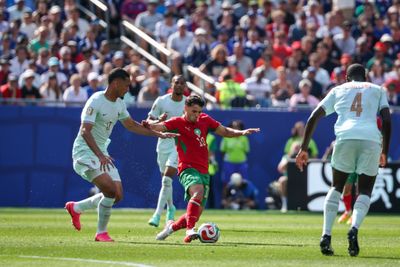
Throughout the night, fans reacted passionately to disputed calls, yellow cards and offside decisions. The loudest moments came with the goals. New Zealand twice took the lead. Iran twice answered.
Each equalizer sent waves of celebration through the crowd, transforming strangers into temporary teammates. Waves traveled across sections. Fans embraced. Cheers rolled through the stadium. Iran defender Ramin Rezaeian emerged as one of the night's standout performers, scoring Iran's first equalizer and assisting on the second.
Yet the soccer itself often felt secondary to the experience unfolding around it.
When I finally connected with Mehdi, he was busy greeting relatives who had traveled from across California for the match.
"Thank you so much for your support," he told our group.
He explained that his family had driven from San Diego while other family members traveled from different parts of the state to attend. For many, the match functioned as both a sporting event and a family reunion. They were among the 70,108 fans who filled SoFi Stadium on Monday night.
When the final whistle blew on the 2-2 draw, the crowd quickly spilled into the streets surrounding the stadium. Fans hugged, sang and exchanged final chants before dispersing into the Los Angeles night.
My group joined the search for food and eventually found what may have been the busiest Raising Cane's restaurant in Los Angeles. A DJ played Latin music in the parking lot while customers waited for their orders. As our group danced beside parked cars, strangers joined us. The scene felt like an extension of the match itself.
For one evening, we all reveled in the joy of being part of a World Cup crowd. In a tournament often viewed through the lens of politics and national identity, I found myself writing about the love of the sport.

Catherine Manso
Author at JNA Press
A seasoned storyteller with a passion for uncovering the human element of global conflicts and humanitarian crises, Catherine Manso is a dedicated multimedia journalist, producer, and globetrotter. Originally from Miami, Florida, Cathy holds a Master's in Journalism: War and International Human Rights. She has honed her skills in research, interviewing, and audio production. Cathy’s work has been featured on platforms such as BBC Radio, Siren, Witham Radio and Southside Broadcasting. Since 2022, she's been freelancing and reporting about Ukraine. Currently living in New York and seeking collaboration opportunities with organizations and individuals who share her dedication to shedding light on diverse communities and advocating for justice.
View Profile